July 27, 2026 · 6 min read
How to Clean a Septic Tank Filter (and When to Call a Pro)

By Luke Aliano
Co-Owner, Quick Pump and Clean
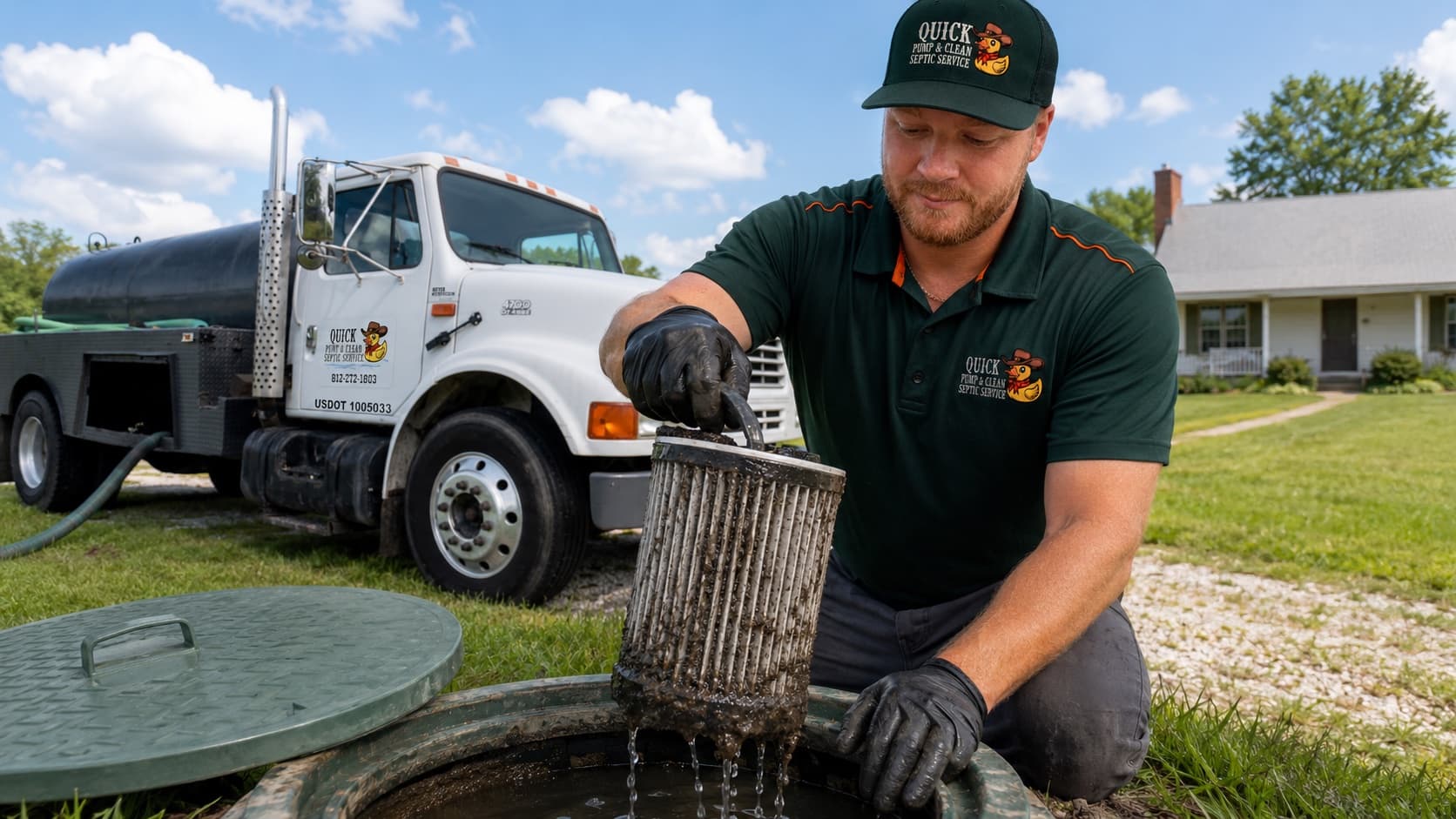
If your drains suddenly slow down and you are dreading the cost of a full pump-out, take a breath: the culprit is often something much smaller and cheaper. Most modern septic tanks have an effluent filter, a removable cartridge in the tank's outlet, and when it clogs it chokes the flow and mimics every symptom of a full tank, from slow drains to gurgling to a backup.
The good news is that cleaning that filter is one of the few septic tasks a careful homeowner can do, and this guide walks through exactly how to clean a septic tank filter step by step. The equally important news is that a septic tank is a genuinely dangerous space, so we will be just as clear about the safety rules and about when you should simply let us handle it, which we do for free on every service call.
What a septic tank filter actually does
Your septic tank separates wastewater into three layers: heavy solids sink into a sludge layer on the bottom, grease and light material float as a scum layer on top, and the relatively clear liquid in the middle flows out to the drain field. The effluent filter sits in the outlet baffle, the last thing the liquid passes before it leaves the tank, and its job is to catch stray suspended solids so they never reach the field.
That is exactly why a dirty filter is such good news in disguise. The filter is designed to clog before solids can escape to your drain field, which is the expensive part of the system. So when it restricts flow and backs your drains up, it is doing its job: it traded a slow drain today for a five-figure field repair later. Rinsing it clean fixes the symptom in minutes.
The filter fits in the outlet baffle, the last stop before liquid flows to the drain field.
How to clean a septic tank filter, step by step
If your tank has an accessible riser and lid at ground level, and you follow the safety rules in the next section, here is the basic process. Work on a calm day, wear gloves and old clothes, and keep children and pets well away from the open lid the entire time.
1. Open the outlet-side lid
Locate the access lid over the outlet end of the tank (the side nearest the drain field) and remove it. Never put your head over the opening or breathe in: septic gases can overcome you in seconds.
2. Note the handle position, then lift straight up
The filter is a cartridge with a handle sitting in the outlet baffle. Note which way it faces so you can reseat it correctly, then pull it straight up and out. Have a bucket ready.
3. Rinse it back into the tank
Hose the trapped solids off the filter and let them fall back into the tank, not onto the ground. The material belongs in the tank so it gets pumped out on your next service.
4. Inspect and reseat
Check the cartridge for cracks or warping. Slide the clean filter back into the baffle in its original orientation, seat it fully, and replace the lid securely.
Safety first: the part most guides skip
A septic tank is a confined space that fills with hydrogen sulfide and methane, gases that can knock a person unconscious with one or two breaths and are the leading cause of septic-related deaths. This is not a scare tactic; it is the single most important paragraph on this page. Never lean into the tank, never reach inside, and never enter it, not even for a moment and not even to retrieve a dropped tool. If something falls in, leave it for a professional.
Only attempt this if you can reach the filter from above, standing at ground level over a riser, with the cartridge coming straight up and out. If your tank lid is buried, if the filter is stuck, if you would have to reach down into the tank, or if you are at all unsure, stop. That is exactly the situation we handle every day, and it is not worth your safety to save a short service call.
When to let a pro handle it (we do it free)
Here is the honest bottom line: cleaning a filter is simple, but doing it safely depends on easy, ground-level access, and a lot of Southern Indiana tanks do not have it. Older rural systems often have buried lids, no riser, and no obvious filter, which turns a two-minute rinse into a dig-and-guess job that is not safe to improvise.
That is why we clean your effluent filter at no charge every time we are out for a pump-out or cleaning, and as a standalone courtesy for customers in our primary service area. There is genuinely no catch: a clean filter protects your drain field, and we would far rather rinse it for free than see you pay for a field repair. If your drains are slow and you are not sure whether it is the filter or a full tank, call us and we will check the filter first and tell you straight.
Frequently Asked Questions
How do I clean my septic tank filter?
If your tank has a ground-level riser and lid, remove the outlet-side lid, lift the filter cartridge straight up out of the baffle, hose the trapped solids off it back into the tank, inspect it for cracks, and reseat it in its original orientation. Never lean into or reach inside the tank because septic gases are deadly. If the lid is buried or the filter is not easy to reach from above, have a professional do it.
How often should a septic filter be cleaned?
About once a year for most households, or any time the tank is pumped. Homes with heavy water use or a garbage disposal may need it more often. A filter that clogs sooner than that is a sign the tank may be due for a pump-out.
Do I need to pump the tank to clean the filter?
No. The effluent filter can be rinsed on its own without pumping the tank, and doing so often clears slow drains caused by a clogged filter rather than a full tank. If both the filter is dirty and the tank is overdue, the filter will clog again quickly, which is a good signal it is time to pump.
Can you clean my septic filter for me?
Yes. Quick Pump and Clean cleans your septic effluent filter at no charge with any pump-out or cleaning, and as a free standalone courtesy for customers in our primary Southern Indiana service area. Call (812) 272-1803 and we will take care of it safely.
Ready to schedule service?